
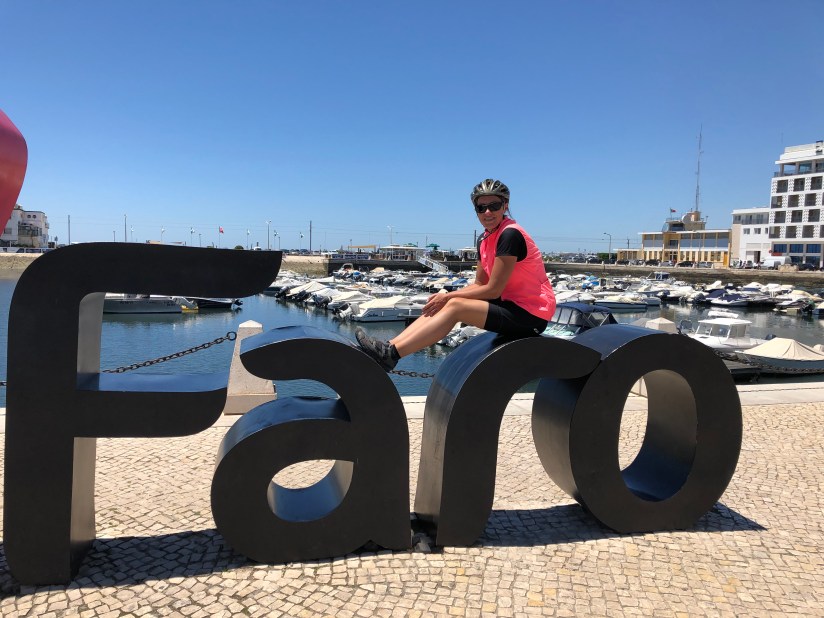
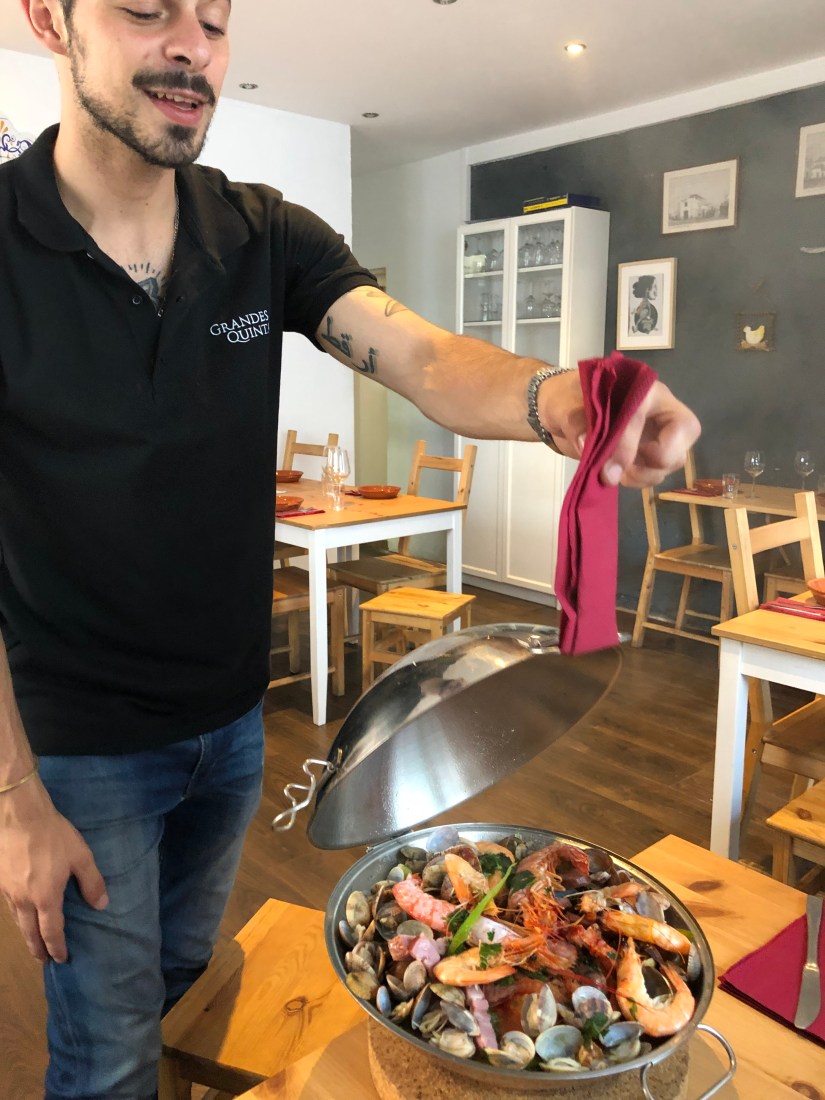
Our evening in Faro began, as we had hoped, with the cataplana, in this case Cataplana à Algarvia, a hot mess of clams, shrimp of various sizes, bacon, pork, onions, tomatoes, and garlic, cooked and served in a stainless steel clamshell like a deep-dish sloppy paella, minus the rice.
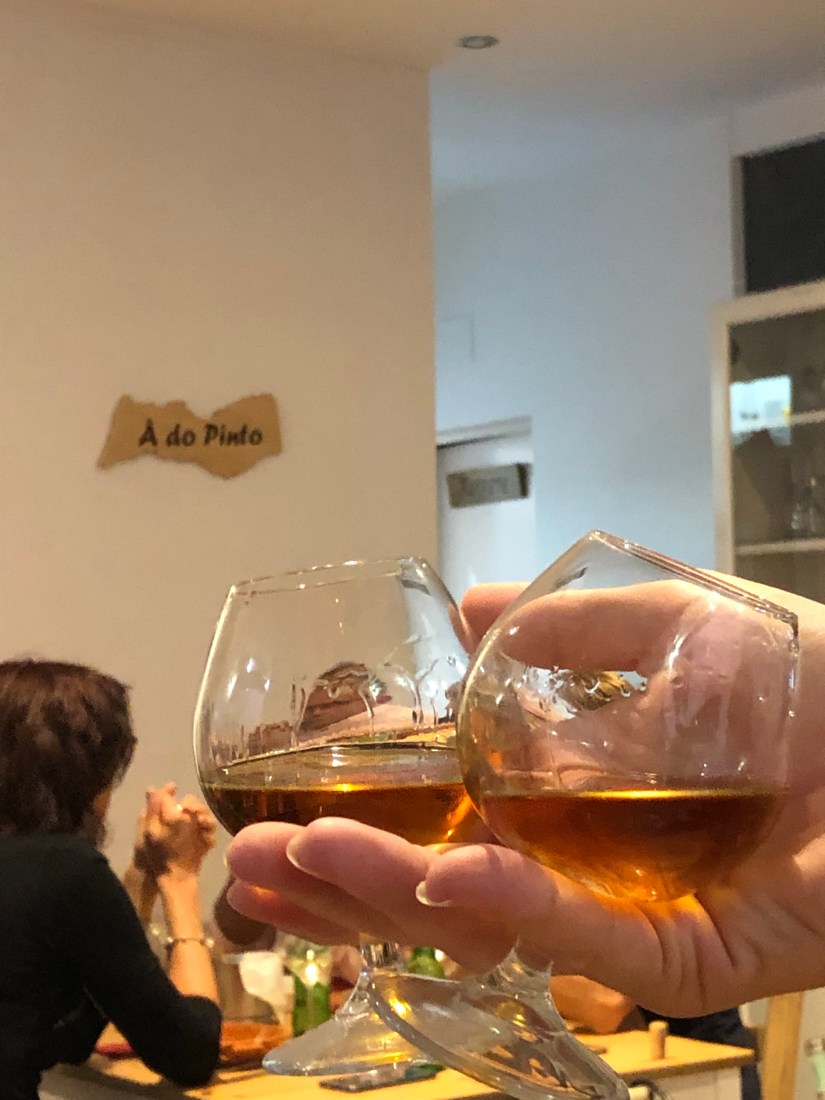
We got so tight with our waiter at tiny À Do Pinto that he came to the table at the end of our meal with a bottle of brandy and poured us two snifters on the house, plus a shot glass for himself and one for the chef, a middle-aged woman in a hair net who came out to join us, with smiles and cross-cultural congratulations all around.
Exhilarated by this, we sat in our hotel’s rooftop bar for a couple more copos, watching the lights and the action along the waterfront below. Despite last night’s revelry, we were up at 7:30 this morning, raring to begin our second riding day. There was the inevitable tending to work email over another elaborate hotel breakfast spread, after which we felt well fueled for a longer head-windy day to the beach town of Lagos.
One thing we’ve noticed this trip is that the Portuguese really don’t want to speak Spanish. French, sure, English, all right, German, definitely, Italian, quite so. But nothing is translated into Spanish. There’s no love lost between these two countries, shared border or no, and no wonder: Spain has a long history of not doing right by Portugal, including unleashing the inquisition upon its much smaller western neighbor. Small wonder menus and road signs conspicuously eschew Español….
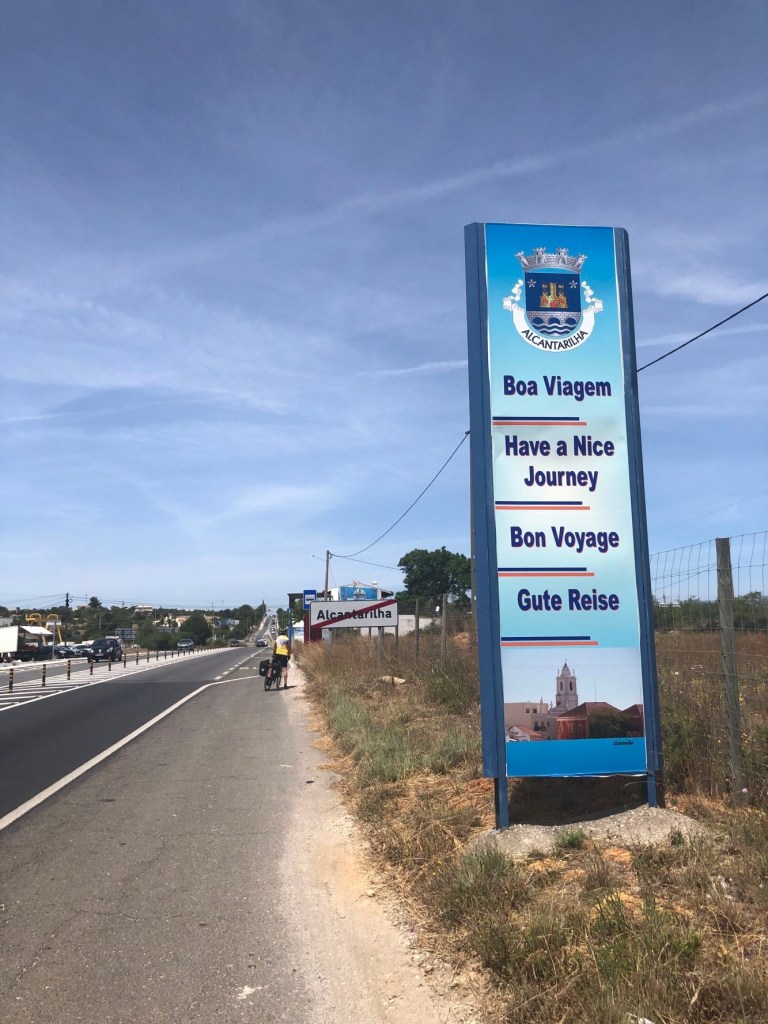
The traffic on this regional arterial, the free alternative to a parallel toll road, was heavy most of the day, and the shoulder, such as it was, came and went without warning. Leaving Faro, things were particularly dicey, shades of Laguna Beach on the Pacific Coast tour: minimal shoulders, where there were any, and those crowded by vegetation sprawl, and giant trucks blowing by a bit too close for comfort. Most drivers, as usual, were respectful, and unlike in the states few felt compelled to attempt a daring pass on too narrow a way or around a blind corner. The gregarious cab driver who took us to the train in Lisbon must be right: the Portuguese are more patient than most.
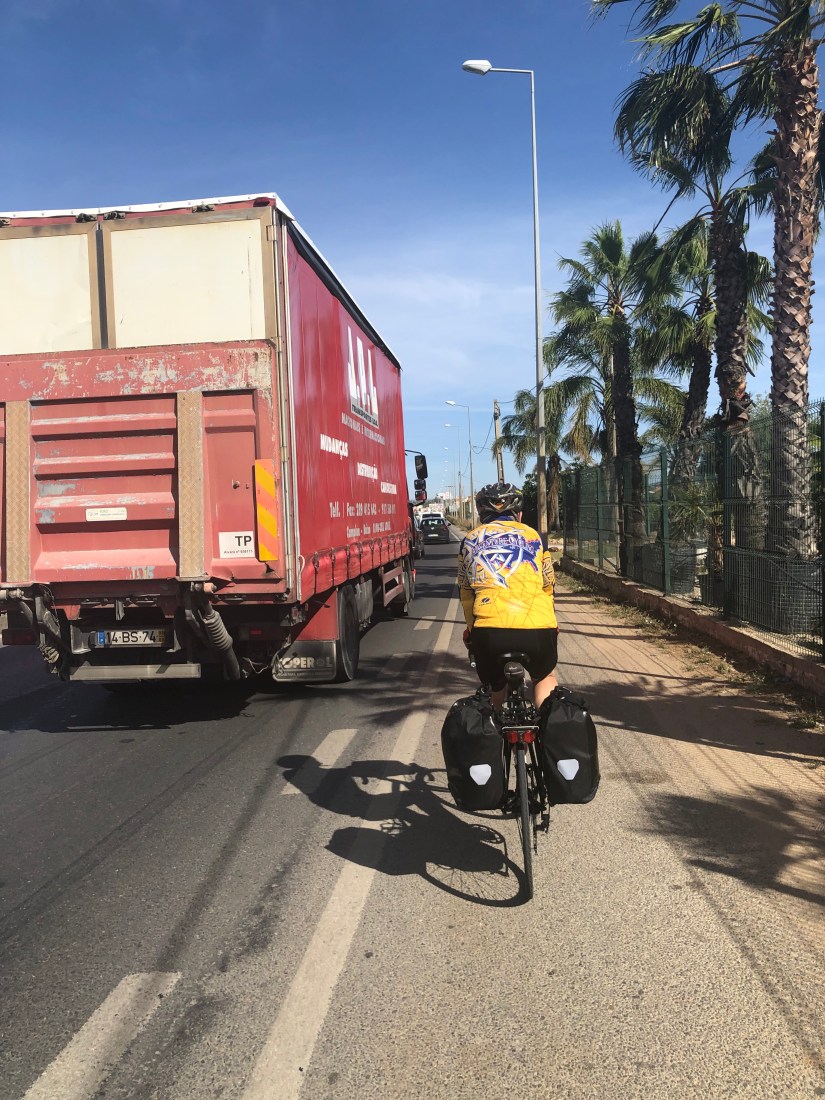
We navigated roundabout after roundabout, always signaling our intentions and proceeding with caution punctuated by daring go-for-its when the wall of traffic occasionally subsided for a few seconds. Sometimes, unexpectedly, there would be a stretch of road so quiet that we could hear the hum of our tires. It didn’t last long.
We rode along sprays of roadside flowers and blossoming trees and bushes, many of which would be annuals, at best, in our high dry desert home, but here in the Algarve’s Mediterranean climate they bloom perennially. And the shoulders are besmirched by relatively little litter, at least compared to the roads along the US Pacific coast.

The other roadside attractions fell into a pattern: orange stands were ubiquitous (though per sack prices varied considerably), as were gas stations and car dealers (diesel! automatic!).


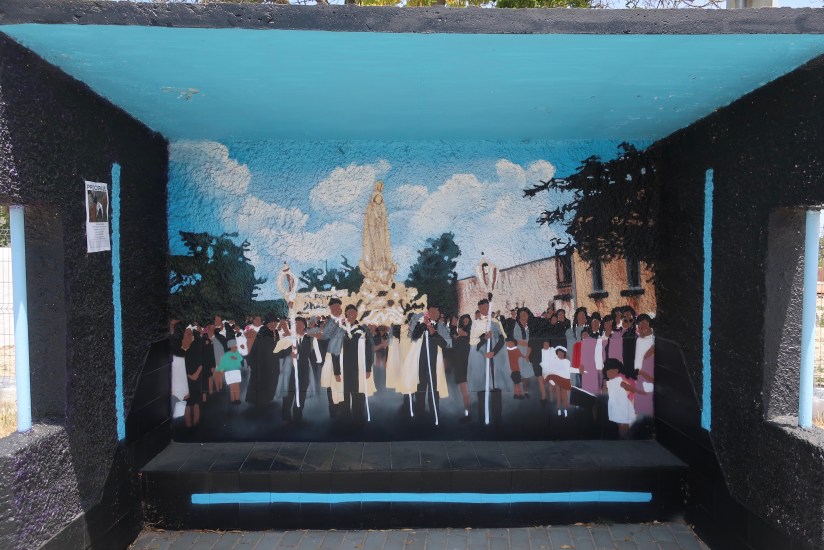
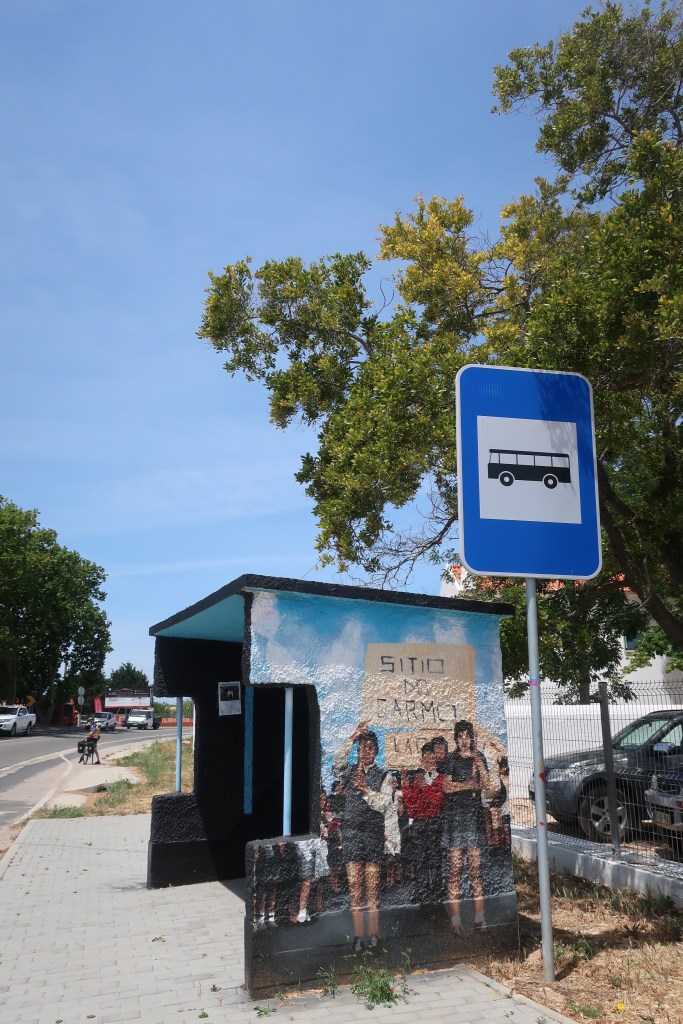
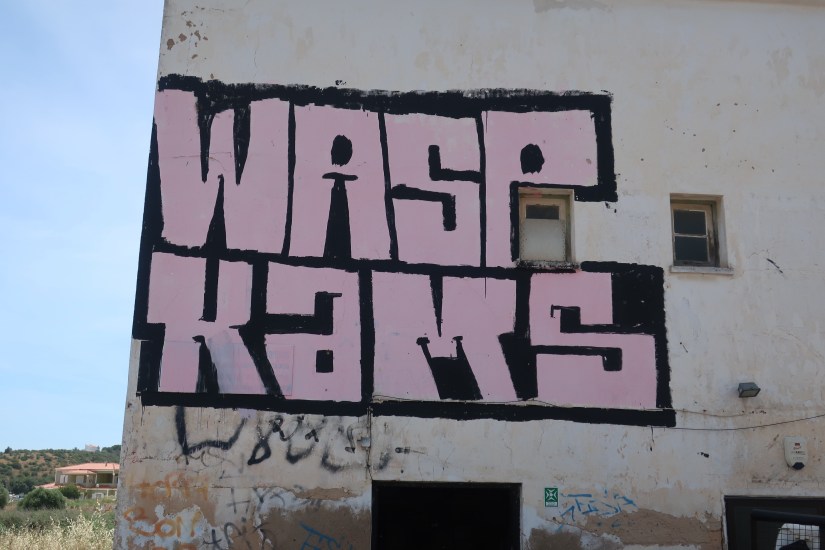
The graffiti we’ve come to associate with Portugal is a constant presence, pieces decorating the most random buildings: uninhabited falling-downs artfully painted, pool-cover shops and bus stop shelters transformed into works of public art. We keep seeing the tags “WASP” and “KAMS”; no one seems to know whether these are signatures or messages (white Anglo-Saxon Protestant?).
Although riding well inland, thanks to our inability to efficiently navigate the rat’s nest of discontinuous tertiary roads closer to the coast, we had occasional glimpses of the sea to the south, looking across miles of housing developments and apartment blocks catering to vacationing or expatriated Europeans taking refuge from far colder, wetter climates.
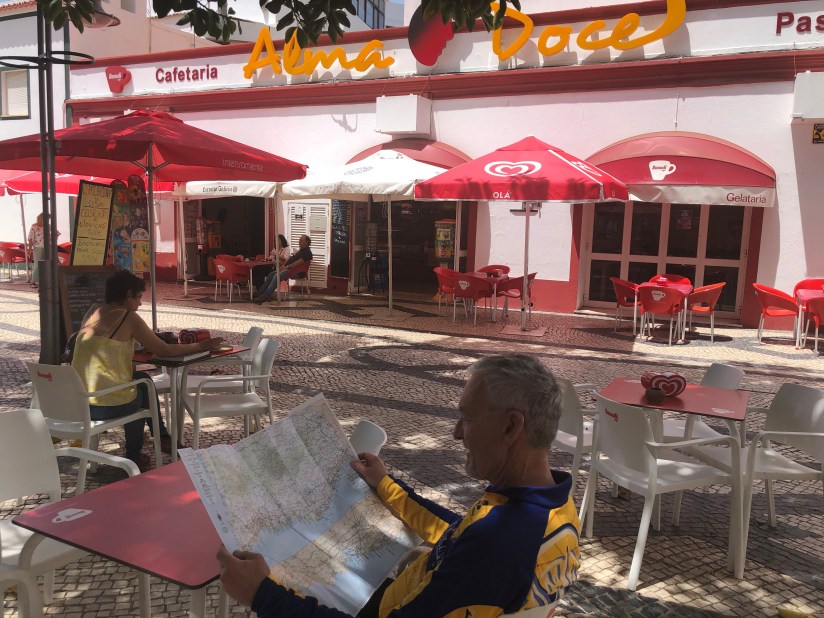
We took lunch in downtown Lagoa, a few dozen yards from the main road, sitting at the shady cafeteria Alma Doce, enjoying pork cutlets (costelledas de cebolada) and bacalhau alma doce (deep-fried cod) with French fries, washed down with many big bottles of ice-cold fizzy water and accompanied by melancholic squeezebox played fitfully by man at folding table selling tattered old paperbacks.
Another 17 or so miles to Lagos, more and more into the 10-15 mph wind, on road much the same as it had been all day. More orange stands, more cars, more petrol stations, more graffiti, more inviting roadside cafes/snack bars/pastelarias that look, each and every one, like the kind of place that creates and holds together a small community. Every now and then another reminder of where we are.

A few miles before we rolled into Lagos the road turned south, the headwind became a blessed tailwind, and this time (“Regardez!”), these sweaty foreigners found their riverside hotel with no difficulty. Showers, clean clothes, and down to the old town to celebrate.
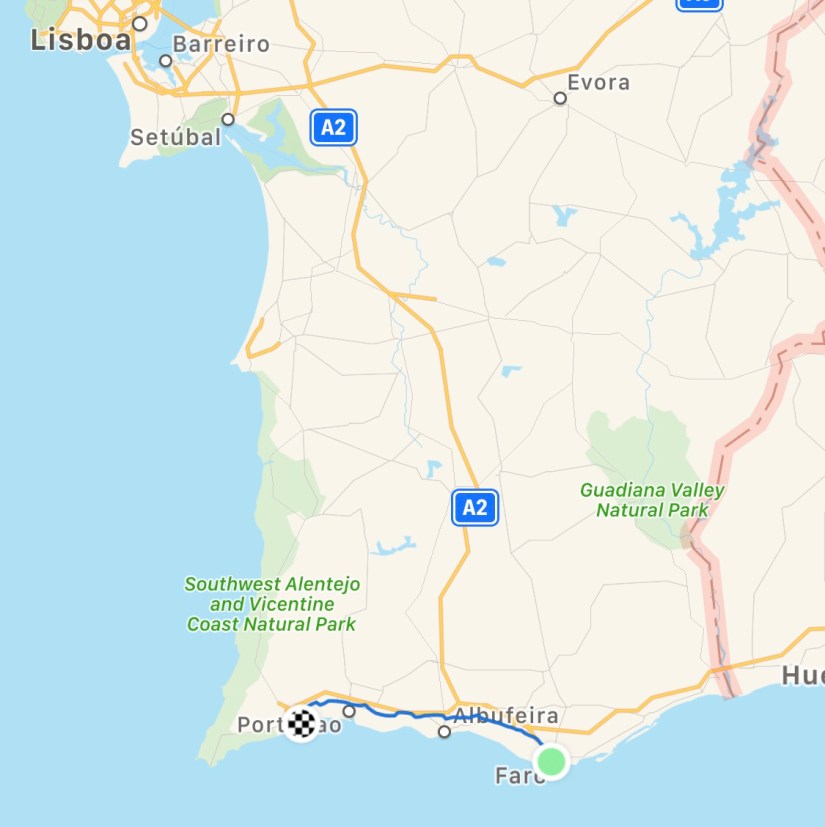
Today was 51.45 miles, with 2103’ of elevation gained. We can feel it.

 Ashley & David on Tour
Great to have you guys back on the road again! Vicarious thrills! Thoughtful insights! And great pictures too. I can’t wait to see if you grab a can of spray paint and join the graffiti horde! Marty Manning
LikeLike
I love the murals. Good looks amazing, now I am hungry.
LikeLike
Another day in the books.. How long did it take you to go the 50+ miles today? So am I reading this right that you guys depend on maps…no GPS??? It’s hard to say where I’d end up looking at a map..lol… Stay safe !!
LikeLike